
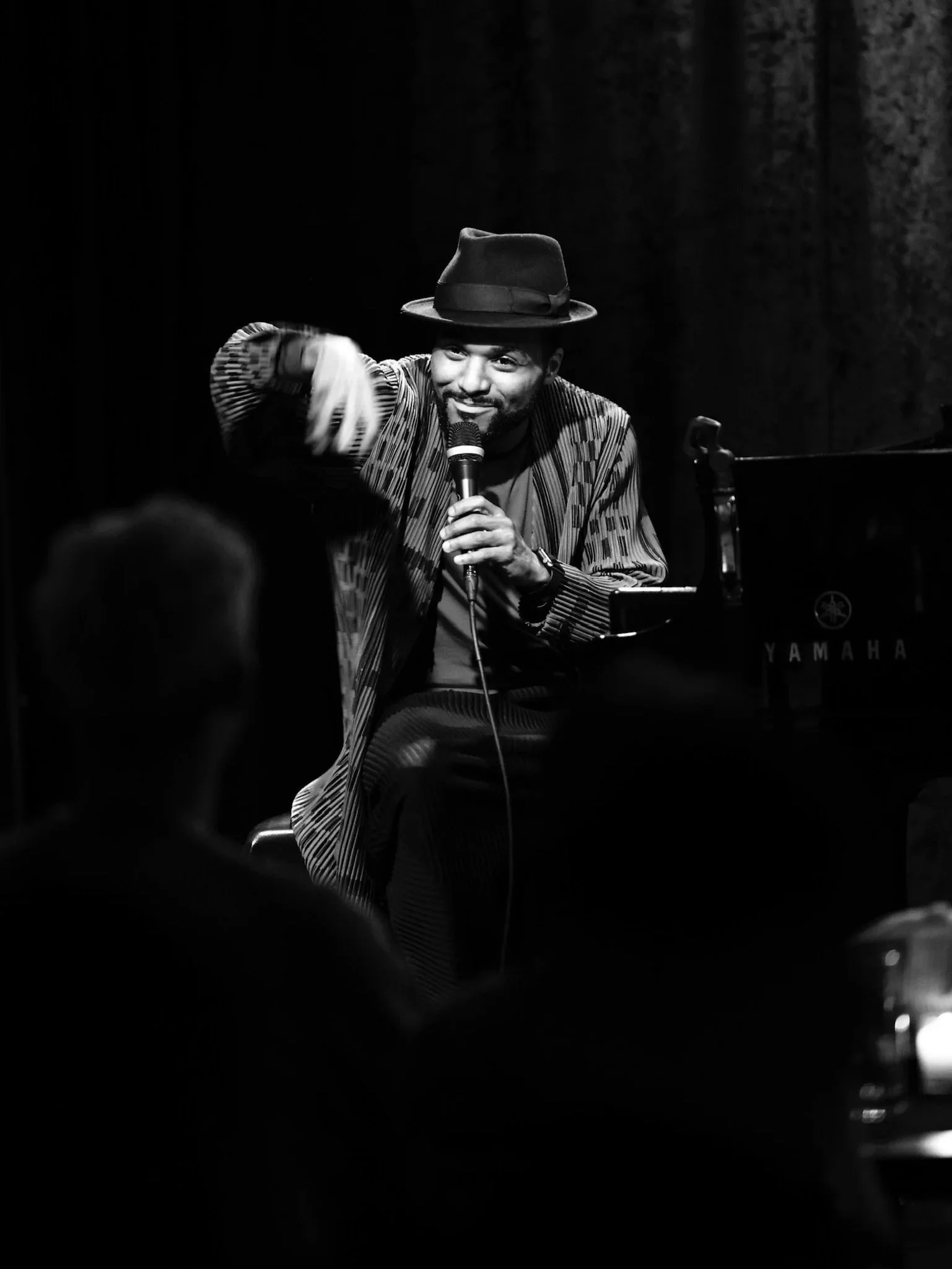
Sullivan Fortner is a pianist, composer and bandleader whose music moves between deep jazz tradition and an irrepressibly exploratory musical imagination. A New Orleans native known for his command of harmony, rhythm and improvisation, Fortner has emerged as one of the defining pianistic voices of his generation, equally distinctive as a solo artist, ensemble leader and collaborator.
His recent work captures the breadth of that musical identity. Following Aria (2015) and Moments Preserved (2018), Fortner released the expansive Solo Game in 2023, an investigation of the possibilities of solo performance that moved beyond acoustic piano to incorporate organ, percussion, electronics, voice and other instruments. Southern Nights followed in 2025, bringing Fortner together with bassist Peter Washington and drummer Marcus Gilmore in a recording deeply connected to his New Orleans roots. The album won the 2026 GRAMMY Award for Best Jazz Instrumental Album and followed his February 2025 appearance on the cover of DownBeat.
Fortner's work as a collaborator has been equally significant. His longstanding musical relationship with vocalist Cécile McLorin Salvant has produced some of contemporary jazz's most acclaimed recordings, including The Window, winner of the 2019 GRAMMY Award for Best Jazz Vocal Album. In 2025, Fortner earned another GRAMMY, this time for Best Jazz Performance with Samara Joy on “Twinkle Twinkle Little Me.”
Across his career he has performed and recorded with artists including Wynton Marsalis, Paul Simon, John Scofield, Ambrose Akinmusire, Dee Dee Bridgewater, Stefon Harris, Fred Hersch, Chief Adjuah and the late Roy Hargrove.
Fortner began playing piano at seven in New Orleans, growing within a musical culture in which rhythm, improvisation, blues and individual expression remain inseparable.
He later earned his Bachelor of Music from Oberlin Conservatory and a Master of Music in Jazz Performance from Manhattan School of Music. That combination of lineage and rigorous study continues to inform a musical language that respects tradition without treating it as fixed.
Whether working with a trio, accompanying a vocalist, performing solo or expanding the piano through electronics and other sound sources, Fortner approaches music as an active field of discovery.
That exploratory impulse is particularly apparent in Solo Game, where Fortner works alone in the studio while extending his musical vocabulary far beyond the conventional boundaries of solo piano.
Fortner's curiosity extends naturally to his work as an educator and mentor. He has taught and presented masterclasses at institutions including Manhattan School of Music, the New Orleans Center for Creative Arts, Purdue University, Belmont University and Oberlin Conservatory, where he has served on the faculty and returned as visiting professor of jazz piano.
His relationship to the music is rooted not simply in technical command, but in sustained engagement with its history, language and evolving possibilities.
-
2026
GRAMMY Award
Best Jazz Instrumental Album
Southern Nights2026
Larry J. Bell Jazz Artist Award
Inaugural Recipient, The Gilmore2026
International Artist of the Year
Deutscher Jazzpreis2025
GRAMMY Award
Best Jazz Performance
“Twinkle Twinkle Little Me” with Samara Joy2024
DownBeat Critics Poll
Rising Star Jazz Group: Sullivan Fortner Trio2020
Shifting Foundation Grant2019
GRAMMY Award
Best Jazz Vocal Album
Cécile McLorin Salvant, The Window2016
Lincoln Center Award for Emerging Artists2015
Cole Porter Fellowship
American Pianists AssociationSelected additional recognition
Leonore Annenberg Arts Fellowship
Western Jazz Presenters Grant -
Cécile McLorin Salvant
Samara Joy
Wynton Marsalis
Paul Simon
John Scofield
Ambrose Akinmusire
Dee Dee Bridgewater
Stefon Harris
Fred Hersch
Chief Adjuah
Roy Hargrove -
“His fundamentals as a player could hardly be stronger, and his instincts as a composer and bandleader are almost startlingly mature.”
- The New York Times
“Fortner beautifully, slowly and deliberately asks the eternal question of the essence of love — his notes dance, come to a halt and resume the twirls.”
- OffBeat Magazine“He is a spiritually thematic soul, alone in the studio he plays his concerns into the music. What we hear is a musician seeking safety in the studio, using every tool nearby to create a forcefield protecting him from a threatening environment and in this chamber, we hear a world emerge.”
- Jason Moran“Fortner [displays] an ease of expression that stems from a longtime commitment to the music.”
- DownBeat“[Sullivan] is one of the best pianists in the world today and he has all of the musical attributes I love: creativity, technique always in the service of expression, joy and humor, fearlessness and pianistic mastery.”
- Fred Hersch -
GRAMMY Award-winning pianist, composer and bandleader Sullivan Fortner has emerged as one of the defining pianistic voices of his generation, combining deep jazz tradition with an exploratory approach to harmony, rhythm and improvisation.
A native of New Orleans, Fortner began playing piano at age seven before studying at Oberlin Conservatory and Manhattan School of Music. His recordings as a leader include Aria (2015), Moments Preserved (2018), Solo Game (2023) and Southern Nights (2025), which won the 2026 GRAMMY Award for Best Jazz Instrumental Album.
Fortner's longstanding collaboration with vocalist Cécile McLorin Salvant includes the GRAMMY-winning The Window, and in 2025 he earned the GRAMMY Award for Best Jazz Performance with Samara Joy for “Twinkle Twinkle Little Me.” His wider collaborations have included Wynton Marsalis, Paul Simon, John Scofield, Ambrose Akinmusire, Dee Dee Bridgewater, Stefon Harris, Fred Hersch, Chief Adjuah and Roy Hargrove.
His honors include the American Pianists Association's Cole Porter Fellowship, Lincoln Center Award for Emerging Artists, Shifting Foundation Grant, DownBeat Critics Poll recognition for the Sullivan Fortner Trio, the inaugural Larry J. Bell Jazz Artist Award and the 2026 Deutscher Jazzpreis for International Artist of the Year.
Fortner is also an active educator and mentor whose teaching and masterclasses have included work with Manhattan School of Music, the New Orleans Center for Creative Arts and Oberlin Conservatory.
-
GRAMMY Award-winning pianist, composer and bandleader Sullivan Fortner is one of the leading jazz pianists of his generation. The New Orleans native's recordings include Aria, Moments Preserved, Solo Game and the GRAMMY-winning Southern Nights. A longtime collaborator of Cécile McLorin Salvant, Fortner has also worked with Samara Joy, Wynton Marsalis, Paul Simon, John Scofield, Ambrose Akinmusire and Fred Hersch. His honors include the Cole Porter Fellowship, Lincoln Center Award for Emerging Artists, Larry J. Bell Jazz Artist Award and 2026 Deutscher Jazzpreis for International Artist of the Year.